Self-care is not about being perfect or “treating yourself”. It means the small, regular things that help you cope, rest and recharge, especially when life feels busy or hard. What works is different for everyone, and small steps count.
Try picking one or two ideas that feel realistic this week.
Body
Mind
Calm
Connection
Creativity and play
Practical
Be kind to yourself
How we speak to ourselves matters. When you notice a harsh inner voice, such as “I’m hopeless” or “I should be coping better”, pause and ask: “What would I say to a good friend in this situation?” Then try saying something similar to yourself.
Different feelings often need different kinds of self-care. Matching what you do to how you feel can make it more helpful.
| If you feel… | Try something… | For example |
|---|---|---|
| Angry, agitated or panicky | Active, to use up the energy | A brisk walk, running up stairs, dancing, cleaning |
| Sad, flat or low | Gentle and nurturing | A warm drink, a blanket, calling someone kind, a slow walk outside |
| Racing thoughts or overwhelmed | Grounding, to come back into your body | Slow breathing, 5-4-3-2-1, holding something cold or textured |
| Lonely or disconnected | Connecting | Message a friend, sit in a café, spend time with a pet |
| Stuck or unmotivated | One small, doable task | Tidy one drawer, have a shower, step outside for five minutes |
Sleep is essential, but it isn’t the only kind of rest we need. If you’re sleeping well and still feel drained, you might be missing a different kind of rest. Physician Dr Saundra Dalton-Smith describes seven types of rest in her book Sacred Rest (Dalton-Smith, 2017). It is a practical framework rather than a research model, so we’ve added what the research says wherever we can.
Physical rest
You might need it if your body feels heavy, sore or run-down.
Try: sleep, a nap, gentle stretching, yoga, a warm shower or bath.
Improving sleep has been shown to reduce depression, anxiety and stress (Scott et al., 2021).
Mental rest
You might need it if your mind is racing or you can’t concentrate.
Try: short breaks during the day, writing tomorrow’s to-do list before bed, switching off notifications after work.
Short breaks of 10 minutes or less can boost energy and reduce fatigue (Albulescu et al., 2022), and switching off from work after hours is linked with less exhaustion and better sleep (Wendsche & Lohmann-Haislah, 2017).
Emotional rest
You might need it if you’re always saying “I’m fine”, or always the one others lean on.
Try: time with someone you can be honest with, journaling, saying no to one thing, talking to a professional.
Social rest
You might need it if being around people leaves you drained.
Try: time with people who leave you feeling better, not worse, and some time alone too.
Supportive relationships are strongly linked with long-term health (Holt-Lunstad et al., 2010).
Sensory rest
You might need it if screens, noise or notifications feel overwhelming.
Try: a screen-free hour, dimming the lights, turning off notifications, a few minutes of quiet.
Creative rest
You might need it if you feel stuck, flat or uninspired.
Try: time in nature, music, art, or simply noticing something beautiful.
Spending around two hours a week in nature is linked with better health and wellbeing (White et al., 2019).
Meaning and values rest
You might need it if you feel disconnected from what matters, or why you do what you do.
Try: time for what gives you meaning, such as faith or prayer, culture, community, volunteering or quiet reflection. (Called “spiritual rest” in the book.)
Try this: what kind of rest do I need?
Add it to your self-care plan below.
Mindfulness means paying attention to the present moment on purpose, with curiosity and without judgement (Kabat-Zinn, 1994). It is not about emptying your mind or feeling relaxed all the time. When your mind wanders, which it will, you simply notice and gently bring your attention back. Practised regularly, mindfulness may help some people manage stress and worry (Healthdirect Australia, 2025).
Grounding skills help you come back to the here and now when you feel overwhelmed, panicky or caught up in memories. There are three main kinds.
5-4-3-2-1 grounding
Pause and notice 5 things you can see, 4 things you can feel, 3 things you can hear, 2 things you can smell and 1 thing you can taste.
Mindful breathing
For a few minutes, notice your breath as it moves in and out. Let your out-breath be a little slower than your in-breath. Whenever your mind wanders, gently bring it back to the breath.
Grounding object
Carry a small object, such as a smooth stone or a textured keyring. When you feel distressed, hold it and notice its weight, temperature and texture.
Give your mind a task
Name all the colours you can see in the room, list animals from A to Z, or count backwards from 100 in sevens.
Describe your surroundings
Describe an object near you in detail, such as its shape, colour, texture and size, as if explaining it to someone who cannot see it.
A calming phrase
Choose a phrase to repeat slowly to yourself, such as “This feeling will pass. I can get through this moment.”
Everyday mindfulness
Choose one daily activity, such as making a cup of tea, showering, washing dishes or walking, and give it your full attention: the sights, sounds, smells and sensations.
Tip: practise when you’re calm
Grounding skills are easier to use in a stressful moment if you have practised them when you feel okay. You might also rate your distress from 0 (calm) to 10 (extremely distressed) before and after an exercise, to notice what helps you most.
Acceptance and Commitment Therapy (ACT) is a therapy developed by Professor Steven Hayes and colleagues (Hayes, Strosahl & Wilson, 2012). Rather than trying to get rid of painful thoughts and feelings, ACT helps you hold them more lightly and put your energy into what matters to you. It works with six core processes: being present, making room for feelings (acceptance), unhooking from thoughts (defusion), the noticing self, values and committed action.
The skills below are described in our own words, mainly drawing on the work of Dr Russ Harris (Harris, 2019).
Dropping anchor
Dropping anchor is a grounding skill from ACT. It is useful when you get caught up in difficult thoughts, feelings or memories. Dropping anchor does not make those feelings go away. Like an anchor holding a boat steady in a storm, it helps you stay steady until the storm passes. It has three steps, remembered as ACE:
Go through the three steps slowly, three or four times. The aim is not to get rid of the feelings, but to be more present and better able to choose what you do next.
“I’m having the thought that…”
When a painful thought hooks you, such as “I’m a failure”, try adding a phrase in front of it: “I’m having the thought that I’m a failure”. This doesn’t argue with the thought. It simply creates a little space, so you can see it as a thought rather than a fact.
Leaves on a stream
This exercise comes from Hayes, Strosahl and Wilson (2012). Imagine sitting beside a gently flowing stream with leaves floating past. As each thought comes, place it on a leaf and watch it drift away, whether it is pleasant, painful or neutral. If you get caught up in a thought, notice that and gently start again.
Making room for feelings (expansion)
This skill is described by Harris (2019). When a strong feeling shows up, notice where you feel it in your body. Breathe slowly into that area. Imagine making room around the feeling, and allow it to be there, even if you don’t like it. You are not trying to make it go away, just to stop struggling with it.
The Choice Point
The Choice Point is a tool described by Harris (2019). In difficult moments, pause and ask: “Is my next step moving me towards the person I want to be, or away from it?” Moves towards might be speaking kindly or going for a walk. Moves away might be snapping at someone or withdrawing. Noticing the choice gives you more freedom to choose.
One small step
Think about what matters most to you, such as being a caring parent, a good friend or looking after your health. Then choose one small, realistic action this week that fits that value.
If focusing on your body, breath or thoughts brings up distressing memories or feelings, keep your eyes open, shorten the exercise or stop. Grounding through your senses and surroundings may feel easier. If you have experienced psychosis, talk with your doctor or psychologist before starting regular meditation practice.
If you’d like to listen to a guided version of dropping anchor, Dr Russ Harris offers free audio recordings on his website.
Colouring detailed patterns can be a simple way to slow down and focus on one thing at a time, and many people find it calming. These A4 pages were designed by Oakwise Therapy: a botanical garden, a mandala and a butterfly, each with small, intricate patterns to colour at your own pace. They are free to print for personal use.
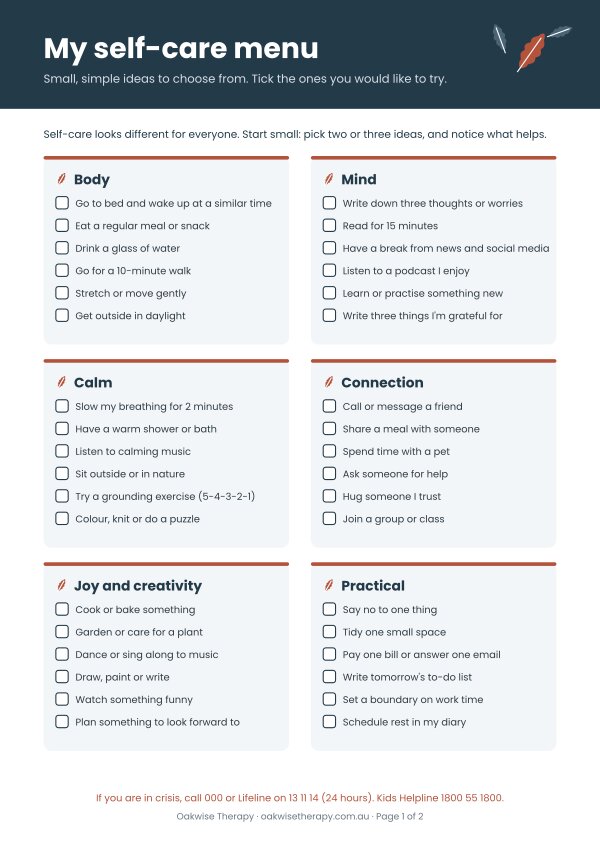
A two-page printable. The first page is a self-care menu with 36 simple ideas across body, mind, calm, connection, joy and creativity, and practical tasks. Tick the ones you would like to try.
The second page is your plan: what drains you, what restores you, your early warning signs, your go-to self-care on hard days, one or two steps for this week, and who you can reach out to. Fill it in when you are feeling okay, and keep it somewhere you can find it on harder days.
Self-care is important, but it is not a replacement for support. If you have been struggling for a while, or self-care no longer seems to help, talking with a psychologist can help you understand what is going on and find a way forward.
If you’d like support, you are welcome to get in touch. You can book a free, no-obligation 15-minute phone call to talk about what is going on and whether Oakwise Therapy is a good fit for you, or send us an email at zohreh@oakwisetherapy.com.au with any questions.
Book a free 15-minute phone callEmail us
If you are in crisis or worried about your safety, call 000, Lifeline on 13 11 14 (24 hours) or Kids Helpline on 1800 55 1800 (ages 5–25, 24 hours). Oakwise Therapy is not a crisis service.
References
A-Tjak, J. G. L., Davis, M. L., Morina, N., Powers, M. B., Smits, J. A. J., & Emmelkamp, P. M. G. (2015). A meta-analysis of the efficacy of acceptance and commitment therapy for clinically relevant mental and physical health problems. Psychotherapy and Psychosomatics, 84(1), 30–36.
Albulescu, P., Macsinga, I., Rusu, A., Sulea, C., Bodnaru, A., & Tulbure, B. T. (2022). “Give me a break!” A systematic review and meta-analysis on the efficacy of micro-breaks for increasing well-being and performance. PLoS ONE, 17(8), e0272460.
Curry, N. A., & Kasser, T. (2005). Can coloring mandalas reduce anxiety? Art Therapy, 22(2), 81–85.
Dalton-Smith, S. (2017). Sacred rest: Recover your life, renew your energy, restore your sanity. FaithWords.
Harris, R. (2019). ACT made simple (2nd ed.). New Harbinger.
Hayes, S. C., Strosahl, K. D., & Wilson, K. G. (2012). Acceptance and commitment therapy: The process and practice of mindful change (2nd ed.). Guilford Press.
Healthdirect Australia. (2025). Mindfulness and mental health. https://www.healthdirect.gov.au/mindfulness-and-mental-health
Holt-Lunstad, J., Smith, T. B., & Layton, J. B. (2010). Social relationships and mortality risk: A meta-analytic review. PLoS Medicine, 7(7), e1000316.
Kabat-Zinn, J. (1994). Wherever you go, there you are. Hyperion.
Khoury, B., Sharma, M., Rush, S. E., & Fournier, C. (2015). Mindfulness-based stress reduction for healthy individuals: A meta-analysis. Journal of Psychosomatic Research, 78(6), 519–528.
Kuyken, W., Warren, F. C., Taylor, R. S., Whalley, B., Crane, C., Bondolfi, G., Hayes, R., Huijbers, M., Ma, H., Schweizer, S., Segal, Z., Speckens, A., Teasdale, J. D., Van Heeringen, K., Williams, M., Byford, S., Byng, R., & Dalgleish, T. (2016). Efficacy of mindfulness-based cognitive therapy in prevention of depressive relapse: An individual patient data meta-analysis from randomized trials. JAMA Psychiatry, 73(6), 565–574.
Scott, A. J., Webb, T. L., Martyn-St James, M., Rowse, G., & Weich, S. (2021). Improving sleep quality leads to better mental health: A meta-analysis of randomised controlled trials. Sleep Medicine Reviews, 60, 101556.
Singh, B., Olds, T., Curtis, R., Dumuid, D., Virgara, R., Watson, A., Szeto, K., O’Connor, E., Ferguson, T., Eglitis, E., Miatke, A., Simpson, C. E. M., & Maher, C. (2023). Effectiveness of physical activity interventions for improving depression, anxiety and distress: An overview of systematic reviews. British Journal of Sports Medicine, 57(18), 1203–1209.
Wendsche, J., & Lohmann-Haislah, A. (2017). A meta-analysis on antecedents and outcomes of detachment from work. Frontiers in Psychology, 7, 2072.
White, M. P., Alcock, I., Grellier, J., Wheeler, B. W., Hartig, T., Warber, S. L., Bone, A., Depledge, M. H., & Fleming, L. E. (2019). Spending at least 120 minutes a week in nature is associated with good health and wellbeing. Scientific Reports, 9, 7730.
Exercises are described in our own words. Colouring pages and the self-care menu and plan are original Oakwise Therapy resources. This page is general information only and does not replace individual professional advice.