
Every couple has moments of disconnection: a sharp comment, a misunderstanding, an argument that goes off track. These ruptures are a normal part of being close to someone. What tends to matter more is how you find your way back to each other afterwards.
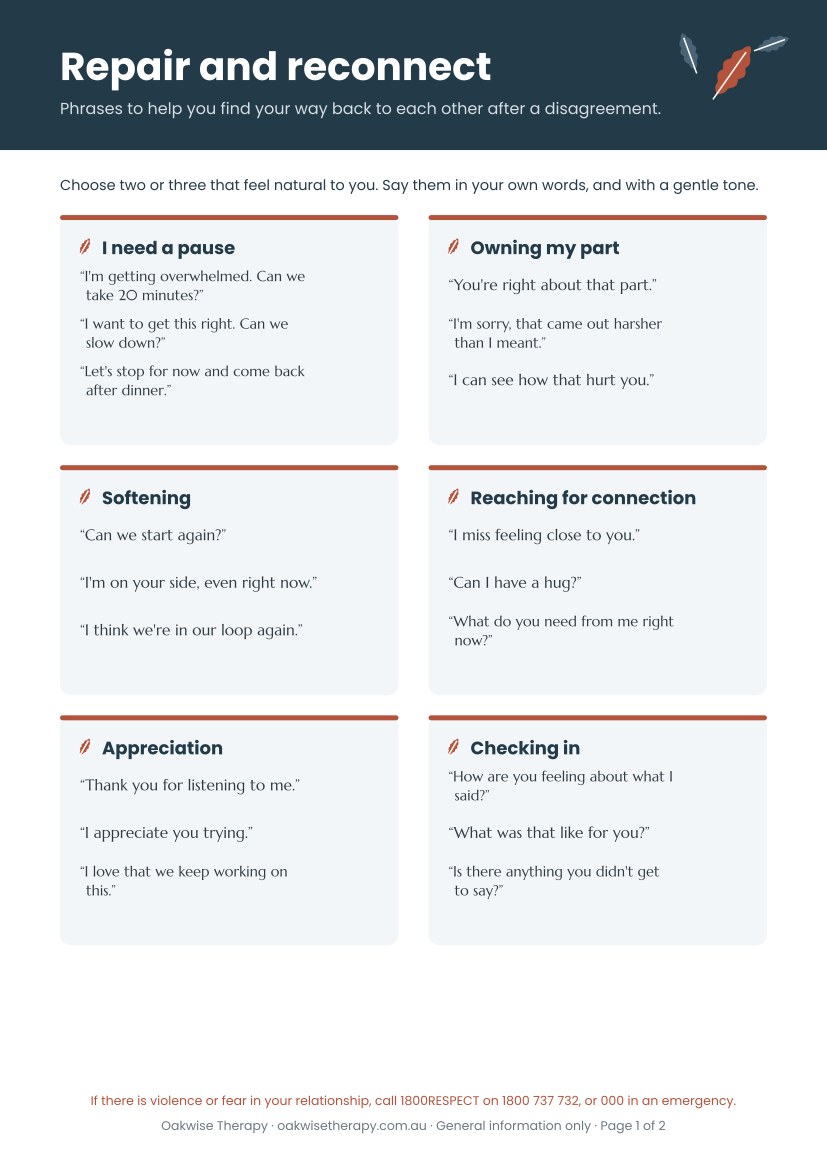
A repair attempt is any word or action that helps calm things down or reconnect during or after conflict. It might be a touch of humour, an apology, a softer tone, or simply “Can we start again?” Research by Drs John and Julie Gottman found that couples who make and accept repair attempts are better able to keep conflict from escalating (Gottman & Silver, 2015).
Accepting your partner’s repair attempts matters as much as making them. If your partner reaches out, even clumsily, try to meet them halfway.
When emotions run high, our bodies go into fight, flight or freeze, and it becomes hard to listen. If either of you feels flooded, take a break of at least 20 minutes. Do something calming, like a walk, slow breathing or music, rather than replaying the argument, and agree on when you’ll come back to it.
Once you both feel settled, these steps can help you understand what happened, without starting the argument again:
Try this: I feel… about… I need…
This simple structure helps you share your experience without blame:
“I feel hurt about the comment at dinner. I need to know you’re on my side when we’re with your family.”
“I feel overwhelmed about the weekend plans. I need us to decide together before saying yes.”
Our two-page printable includes repair phrases to choose from, the “I feel… about… I need…” prompts, and a pause plan to fill in together.
You might also find our pages on the Four Horsemen and the pursue–withdraw cycle helpful.
If arguments keep escalating, or repair feels impossible, couple counselling can be a space to practise new ways of talking and reconnecting. Oakwise Therapy offers online couple counselling for couples anywhere in Australia.
If there is violence, threats, fear or controlling behaviour in your relationship, these strategies are not the right fit and couple counselling may not be safe. Please see our Domestic Violence page, call 1800RESPECT on 1800 737 732 (24 hours), or 000 in an emergency.
Bushman, B. J. (2002). Does venting anger feed or extinguish the flame? Catharsis, rumination, distraction, anger, and aggressive responding. Personality and Social Psychology Bulletin, 28(6), 724–731.
Driver, J. L., & Gottman, J. M. (2004). Daily marital interactions and positive affect during marital conflict among newlywed couples. Family Process, 43(3), 301–314.
Fincham, F. D., Beach, S. R. H., & Davila, J. (2004). Forgiveness and conflict resolution in marriage. Journal of Family Psychology, 18(1), 72–81.
Gordon, A. M., Impett, E. A., Kogan, A., Oveis, C., & Keltner, D. (2012). To have and to hold: Gratitude promotes relationship maintenance in intimate bonds. Journal of Personality and Social Psychology, 103(2), 257–274.
Gottman, J. M., & Silver, N. (2015). The seven principles for making marriage work (Rev. ed.). Harmony Books.
Johnson, S. (2008). Hold me tight: Seven conversations for a lifetime of love. Little, Brown.
This page is general information only and does not replace individual professional advice.